


Shopify vs WooCommerce is one of the first decisions U.S. entrepreneurs face when building or upgrading an online store. Both platforms can power successful ecommerce businesses, but they take very different approaches to store management, customization, pricing, and technical maintenance.
Shopify is a hosted ecommerce platform designed to make launching and managing a store relatively straightforward. WooCommerce is a free, open-source ecommerce platform built for WordPress, giving store owners greater control over hosting, customization, and the underlying website.
In this guide, you’ll compare Shopify and WooCommerce across cost, ease of use, design flexibility, performance, SEO, payment options, scalability, and maintenance so you can choose the platform that fits your business goals.
Shopify vs WooCommerce: What’s the Difference?
At a high level, Shopify gives you a packaged ecommerce environment, while WooCommerce gives you an ecommerce framework that you can build and customize within WordPress.
Shopify handles hosting, core infrastructure, security, and much of the technical setup for you. WooCommerce itself does not charge a platform subscription or revenue share, but you are responsible for choosing hosting and adding the extensions and services your store requires.
That fundamental difference affects almost every part of the buying decision.
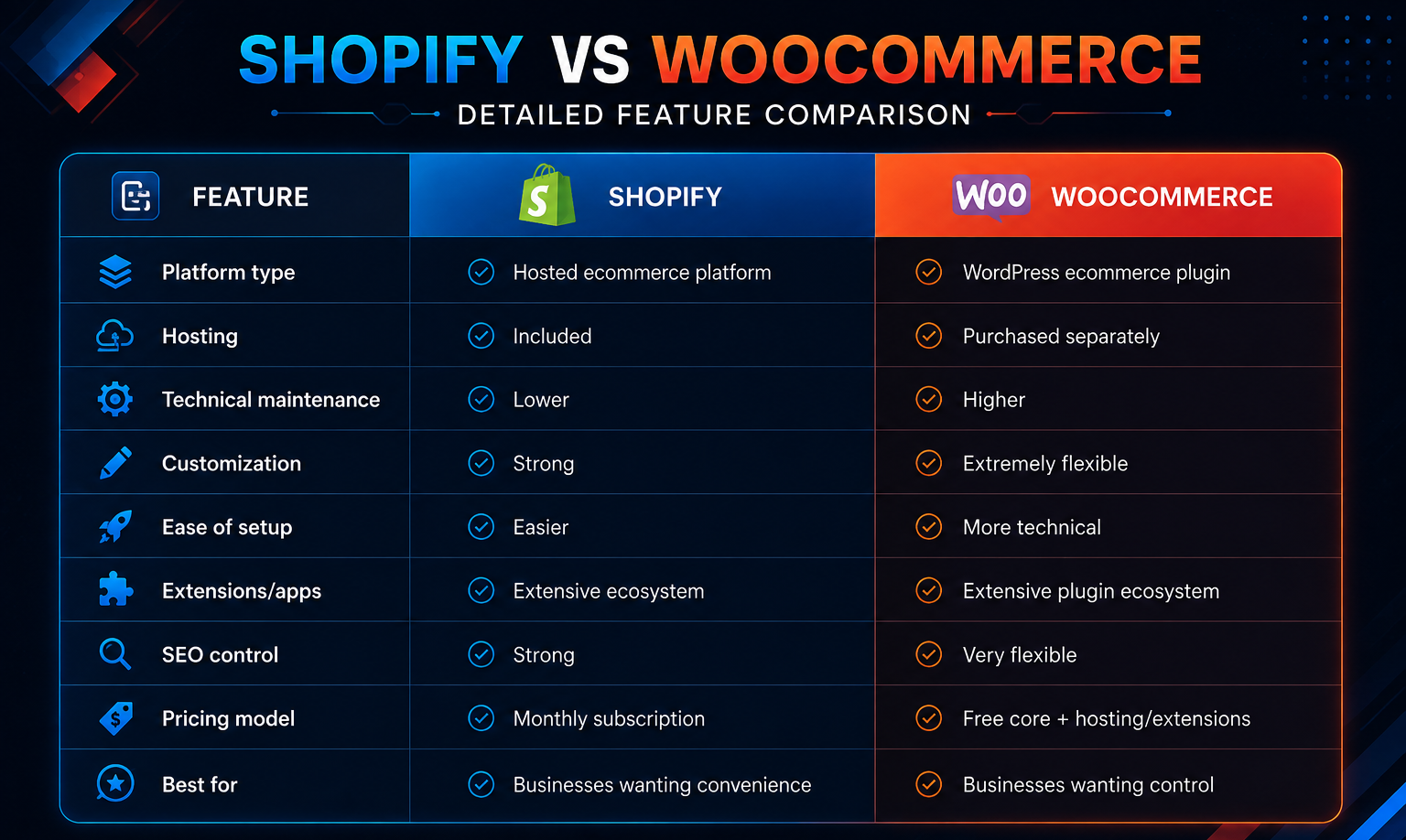
Shopify vs WooCommerce: Cost Comparison
Cost is often the first issue small businesses consider, but the lowest advertised price isn’t necessarily the lowest total cost.
Shopify currently offers subscription plans with different features and usage levels. Its pricing page lists plans such as Basic, Grow, Advanced, and Shopify Plus, with pricing varying based on billing terms and plan level.
WooCommerce has a different model. The core platform is free, with no platform subscription or revenue share, but businesses typically pay for hosting, extensions, themes, development, security, and other services as needed. WooCommerce estimates hosting for many stores at roughly $25–$350 per month, while extensions can cost about $29–$299 per year each.
Which Platform Is More Affordable?
For a very small business, WooCommerce can appear cheaper because you aren’t paying a platform subscription for the core software.
However, Shopify can become more predictable because hosting and much of the platform infrastructure are bundled into the subscription. This may reduce the amount of technical management required.
A useful way to think about the cost is:
Shopify: subscription + apps + payment processing + optional development
WooCommerce: hosting + extensions + themes + payment processing + maintenance + optional development
The right choice depends on whether your business values predictable simplicity or maximum control.
Ease of Use: Shopify vs WooCommerce
For beginners, Shopify generally has the advantage.
Shopify is designed around a centralized administration experience where you can manage products, orders, payments, themes, inventory, and other ecommerce functions from one platform. Shopify also provides 24/7 support on its current plans.
WooCommerce is also user-friendly once configured, but the overall experience can require more technical decisions because your WordPress website, hosting environment, plugins, themes, backups, updates, and security all become part of your ecommerce setup.
Example: A First-Time Store Owner
Imagine a U.S. entrepreneur launching a skincare brand with 30 products.
If the business owner wants to get online quickly without dealing with hosting configuration or plugin compatibility, Shopify may be the more convenient choice.
If the owner already operates a WordPress website and wants complete control over the site’s architecture and content, WooCommerce may make more sense.
Design and Customization
Both platforms provide substantial design flexibility, but they offer that flexibility differently.
Shopify uses themes, theme customization, apps, APIs, and development tools to extend the store. More advanced plans also provide expanded customization and API capabilities.
WooCommerce gives you the broader WordPress ecosystem. You can modify templates, WordPress functionality, plugins, database structures, hosting configurations, and other parts of the website.
This makes WooCommerce particularly attractive when the ecommerce store is only one component of a larger content-heavy website.
Which Has Better Customization?
For most businesses, Shopify provides enough customization to create a highly professional store.
For businesses with unusual workflows, highly customized WordPress environments, or very specific technical requirements, WooCommerce can offer more freedom.
The practical question isn’t “Which one can be customized more?”
It’s:
“How much customization does your business actually need?”
Shopify vs WooCommerce for SEO
Both platforms can perform well in search engines when they are properly optimized.
Shopify provides essential ecommerce SEO capabilities such as editable page titles, meta descriptions, structured content, canonicalization, and other SEO controls. It also integrates with a large ecosystem of marketing and SEO applications.
WooCommerce benefits from WordPress’s extensive SEO ecosystem, which provides businesses with significant control over content, technical SEO, schema, URLs, blogs, landing pages, and optimization workflows.
For content-driven businesses, WooCommerce can be especially attractive because WordPress is fundamentally designed around content publishing.
For merchants who prioritize ecommerce operations and want SEO without managing a complex technical environment, Shopify is often easier to maintain.
Ultimately, SEO performance depends more on execution than platform selection.
A fast store with strong architecture, useful content, optimized product pages, quality links, and good user experience can outperform a poorly optimized store on either platform.
Apps, Plugins, and Integrations
Another important part of the Shopify vs WooCommerce decision is extensibility.
Shopify’s ecosystem includes thousands of apps for marketing, reviews, subscriptions, analytics, inventory, shipping, customer support, product customization, and automation. Shopify also supports custom apps through its APIs, with capabilities varying by plan.
WooCommerce relies heavily on WordPress plugins and extensions. You can add functionality for subscriptions, memberships, bookings, advanced product options, wholesale, payment gateways, CRM systems, and virtually any other requirement that can be supported through WordPress.
When Custom Development Makes Sense
Standard apps and plugins are usually enough for common ecommerce requirements.
Custom development becomes more valuable when you need:
- A unique checkout or customer journey
- Integration with internal business software
- Custom pricing rules
- Advanced product configuration
- Automated order workflows
- Specialized inventory systems
- Custom customer portals
For Shopify merchants with complex requirements, working with a Shopify development company can help turn business processes into reliable storefront functionality rather than forcing the business to adapt to a generic app.
Similarly, a specialized Shopify app development agency can create custom functionality when an existing Shopify app doesn’t meet your requirements.
Payment Processing
Payment flexibility is another area where business owners should look beyond headline features.
Shopify supports Shopify Payments as well as numerous third-party payment providers. Shopify notes that more than 100 third-party credit card providers are supported, while fees for third-party payment providers can vary according to your Shopify plan and payment setup.
WooCommerce allows merchants to choose their own payment processor, with the platform itself not adding a separate platform transaction fee. You still pay the processing fees charged by the selected payment provider.
For businesses with specific payment requirements, compare the actual payment processors available in your target market before committing to a platform.
Performance and Maintenance
Performance depends on more than the ecommerce platform.
Your theme, images, apps, plugins, scripts, hosting, database configuration, and third-party services can all affect store speed.
Shopify handles much of the underlying infrastructure, which can make maintenance easier for small teams.
WooCommerce gives you more control but also more responsibility. Hosting quality, plugin conflicts, updates, backups, caching, security, and database optimization may require ongoing attention.
Which Is Easier to Maintain?
Shopify wins for simplicity.
WooCommerce wins for control.
That’s one of the most important distinctions in this Shopify vs WooCommerce comparison.
Scalability: Which Platform Is Better for Growth?
Both platforms can support businesses ranging from small stores to large ecommerce operations.
Shopify offers higher-tier plans designed for larger and more complex businesses, including Shopify Plus. Current Shopify Plus pricing starts at $2,300 per month under certain contract terms, while the platform provides expanded capabilities for enterprise businesses.
WooCommerce can also scale significantly, particularly when supported by appropriate hosting, development architecture, caching, and database optimization.
The difference is how scaling is managed.
With Shopify, much of the infrastructure is managed for you.
With WooCommerce, you have greater responsibility for building an infrastructure capable of handling increased traffic and transaction volume.
Shopify vs WooCommerce: Which Is Better for Your Business?
There isn’t one universal winner.
Shopify may be better if you:
- Want to launch quickly
- Prefer predictable platform management
- Don’t want to manage hosting
- Have a small technical team
- Want an ecosystem of ecommerce-focused apps
- Plan to scale without managing infrastructure yourself
WooCommerce may be better if you:
- Already use WordPress
- Need extensive customization
- Want greater hosting control
- Have strong technical resources
- Run a content-heavy website
- Want maximum flexibility over the site’s architecture
What Should a U.S. Small Business Choose?
For a new U.S. business that wants to start selling online quickly, Shopify is often the simpler starting point.
For an established WordPress business with highly customized requirements, WooCommerce can be the better long-term fit.
Consider this simple example:
A startup selling custom candles with 50 products, standard shipping, and common payment methods may benefit from Shopify’s simplicity.
A company selling configurable industrial equipment with complex product rules and a heavily customized WordPress site may benefit from WooCommerce’s flexibility.
Your decision should be based on business requirements rather than platform popularity.
How to Choose the Right Platform
Before making your decision, answer these five questions:
- How technical is your team?
- How much customization will your store require?
- What payment providers do you need?
- How much time can you dedicate to maintenance?
- What will your business need three years from now?
Don’t choose a platform solely because it is cheaper today.
The better platform is the one that minimizes your total cost of ownership while supporting your operational and growth requirements.
Shopify vs WooCommerce: Final Verdict
So, which platform wins?
Shopify is generally the better choice for businesses that prioritize simplicity, speed, managed infrastructure, and easier day-to-day ecommerce operations.
WooCommerce is generally the better choice for businesses that prioritize ownership, technical control, WordPress integration, and extensive customization.
Neither platform is automatically better for every ecommerce business.
The right decision comes down to your products, customers, technical resources, budget, growth plans, and operational requirements.
For businesses that choose Shopify but need more than a standard theme and basic apps, professional implementation can make a substantial difference. A qualified Shopify development company can help with store architecture, custom features, integrations, conversion-focused design, and ongoing optimization. For businesses requiring specialized functionality, an experienced Shopify app development agency can also build custom solutions around specific workflows.
Frequently Asked Questions
Is Shopify better than WooCommerce for beginners?
Generally, Shopify is easier for beginners because hosting and much of the technical infrastructure are managed within the platform. WooCommerce offers more control but typically requires more hands-on management.
Is WooCommerce cheaper than Shopify?
WooCommerce’s core software is free, while Shopify uses a paid subscription model. However, WooCommerce stores can incur costs for hosting, extensions, themes, maintenance, and development, so the total cost depends on the store’s requirements.
Can I migrate from WooCommerce to Shopify later?
Yes. Businesses can migrate products, customers, orders, and other data from WooCommerce to Shopify using migration tools, apps, or custom development. The migration should be carefully planned to preserve URLs, SEO signals, product data, and customer experience.
Conclusion
Choosing between Shopify and WooCommerce is less about finding a universal winner and more about finding the platform that fits your business.
Shopify is compelling for entrepreneurs who want a streamlined ecommerce platform with less technical maintenance. WooCommerce stands out for businesses that want deep control over their WordPress-based store.
Before making the final decision, evaluate your budget, technical capabilities, customization requirements, payment needs, and long-term growth strategy.
Ready to build a Shopify store that is designed around your business goals?
Contact Pixel Web Experts to discuss your Shopify development requirements and create an ecommerce store built for growth.